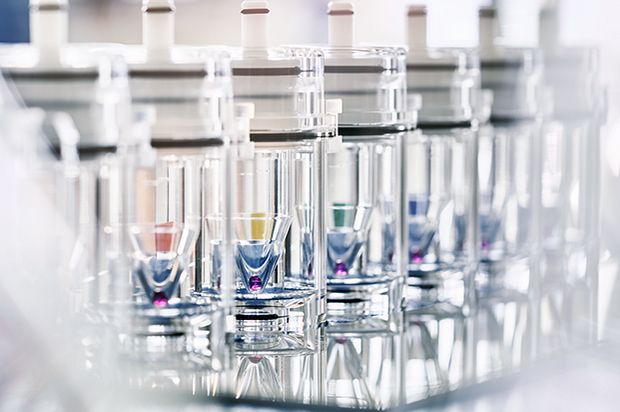
In the world of research there is always the apprehension that in-vitro results may not accurately replicate conditions that occur inside the body. Enter the USP Apparatus 4 and the wide range of new benefits it brings, in particular, as a suitable bridge between in-vitro and in-vivo studies.
Of course, USP 4 is not meant to replace USP 1 or 2 but rather offer new ways to conquer dosage form challenges. It can be used with both small and large tablets, powders, suppositories, implants and stents, and provides unique solutions to determine their dissolation rates. For example, when determining the dissolution rate of pure solid substances with USP 4 compared with USP 1 and 2, a notable difference is elimination of the need for compression as substances are tested in loose powder or granulate form, whereas with USP 1 and 2 compression is necessary (which in-turn can ultimately affect particle size, specific area, etc).
When looking further at USP Apparatus 4 we can break it down into two main modes of operation. That of Open Configuration and that of Closed Configuration. Both have advantages of their own, and we use both at Quinta-Analytica, yet work in slightly different ways. Whereas in the open configuration the flow-through cell apparatus is used as a system where fresh solvent feeds directly from the reservoir and passes constantly through the cell where the dosage form is accommodated; in a closed system on the other-hand it recycles a fixed volume of that medium. Ultimately enabling a wider range of options for the research.
Diving deeper into the open configuration, the reservoir volume is not fixed and can be increased/decreased to ensure that the concentration of the drug is such that it can be detected accurately; a calculation is then done by taking the average concentration which is divided by the number of minutes elapsed and that results in an estimate of the release rate over the time interval. This type of setup is especially useful for drugs which are not readily soluble. The closed configuration on the other hand, follows a different flow; a pump returns the medium via an in-line reservoir (which further allows heating/ stirring/ sampling etc. during the process) and then recycles that to the cell. Calculating the concentration of analyte and the volume in the system, gives the cumulative release result.
Tying everything together, clearly both options have advantages and the versatility of the USP 4 Apparatus, with respect to alteration of flow and the in-vitro/in-vivo correlations of the poorly soluble compounds, demonstrates quite clearly that the method is more reliable, reproducible and discriminating than other systems.
Our partner Sotax has prepared a detailed overview for USP 4, which you can download here.